AI Face Forensics & CCSC Poster Award
What I did
I studied spectral and edge cues in generated versus real faces, controlled content differences, and presented the work at CCSC Eastern.
Research: June–October 2026 · CCSC presentation: October 9–10, 2026
My contribution
Independent student researcher; academic guidance from Kathy Macropol
- Prepared the study data and extracted eight interpretable forensic features.
- Implemented content matching, statistical comparisons, and model evaluation.
- Prepared the research poster and presented the findings at CCSC Eastern.
Outcome
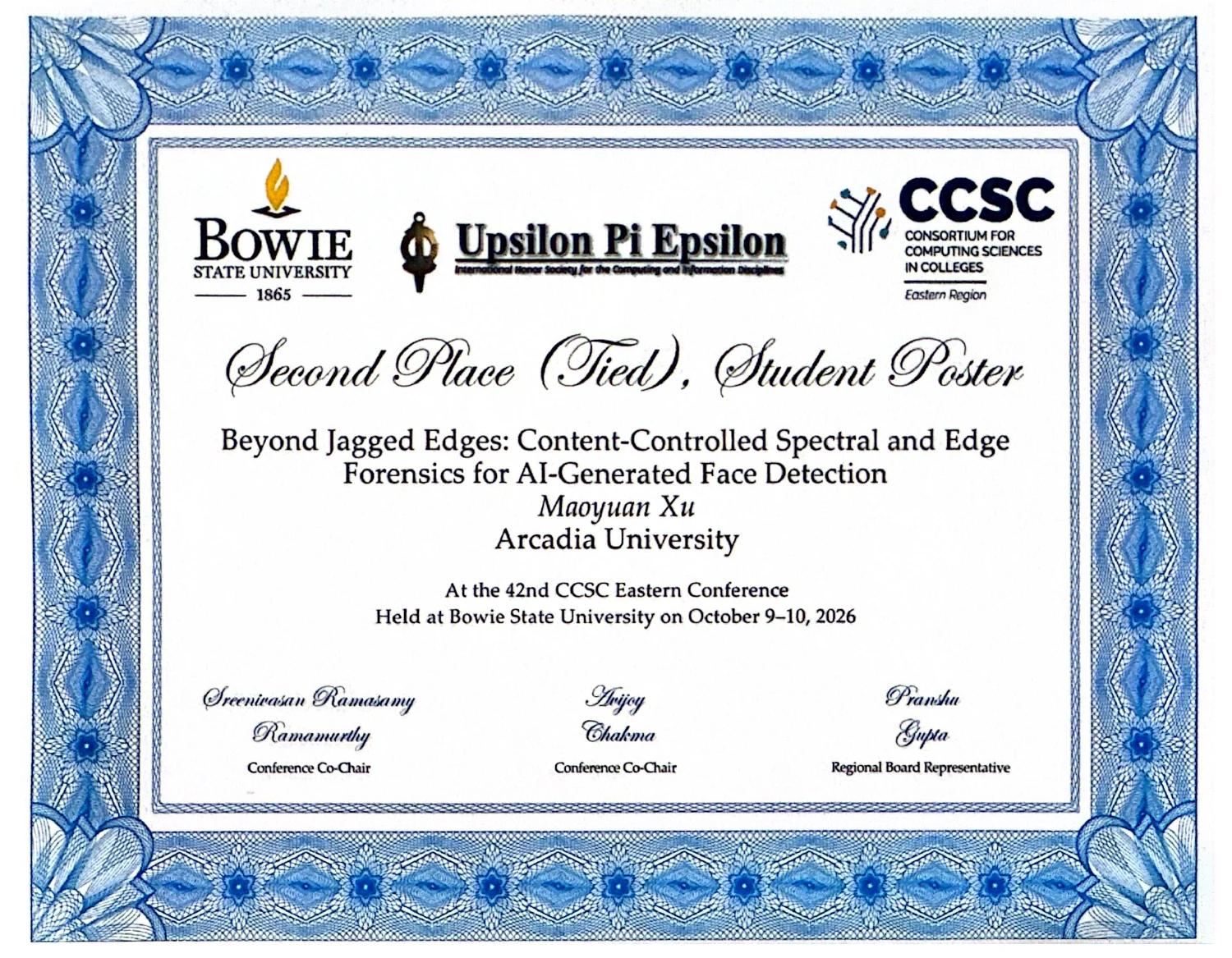
ROC-AUC 0.7482 on a 400-image internal test; Second Place (Tied), Student Poster, CCSC Eastern 2026.
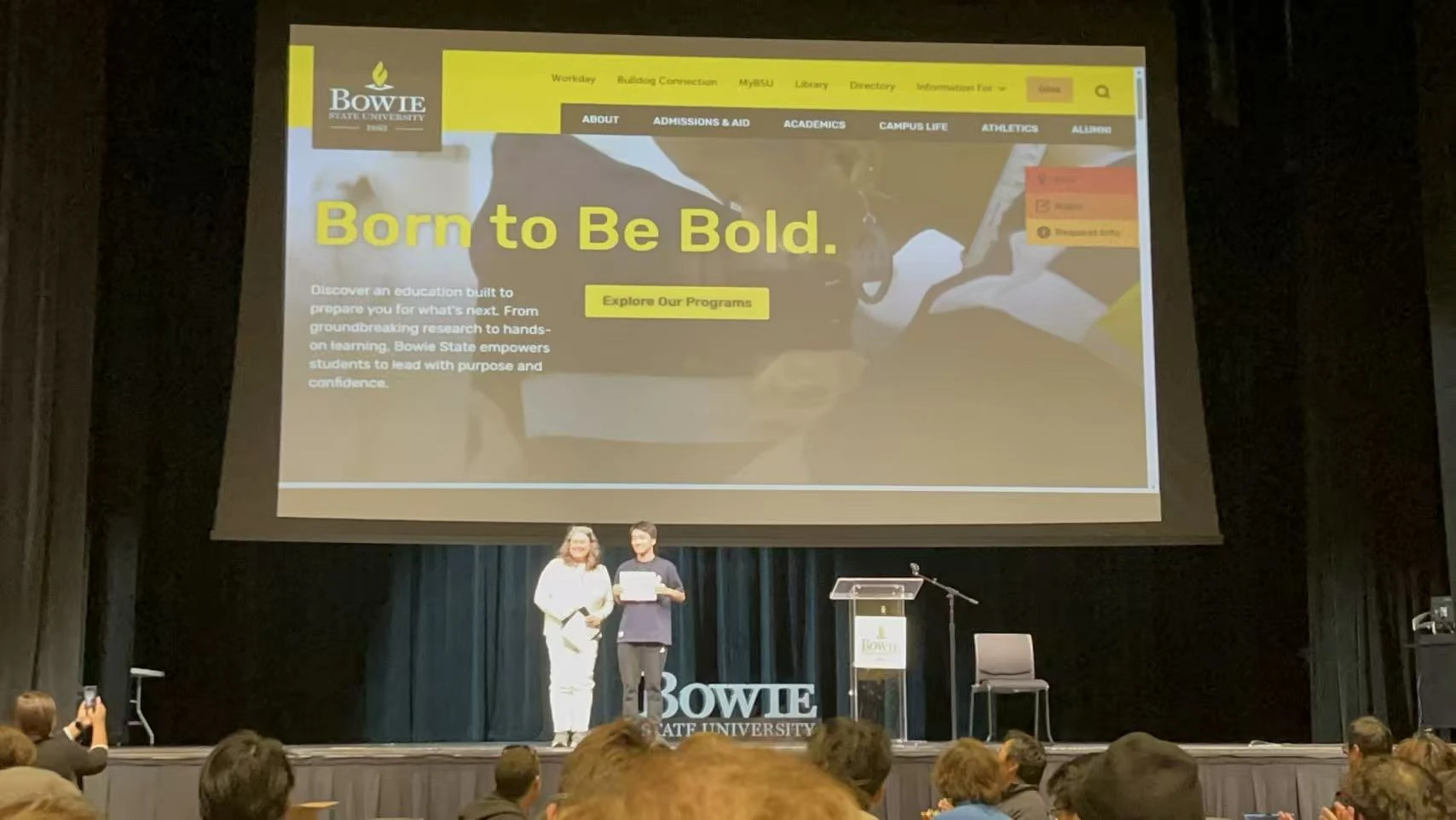
Presenting the work at CCSC
I presented Beyond Jagged Edges: Content-Controlled Spectral and Edge Forensics for AI-Generated Face Detection at the 42nd CCSC Eastern Conference, hosted by Bowie State University on October 9–10, 2026. The student poster received Second Place (Tied). The photograph above records the award ceremony.
The question
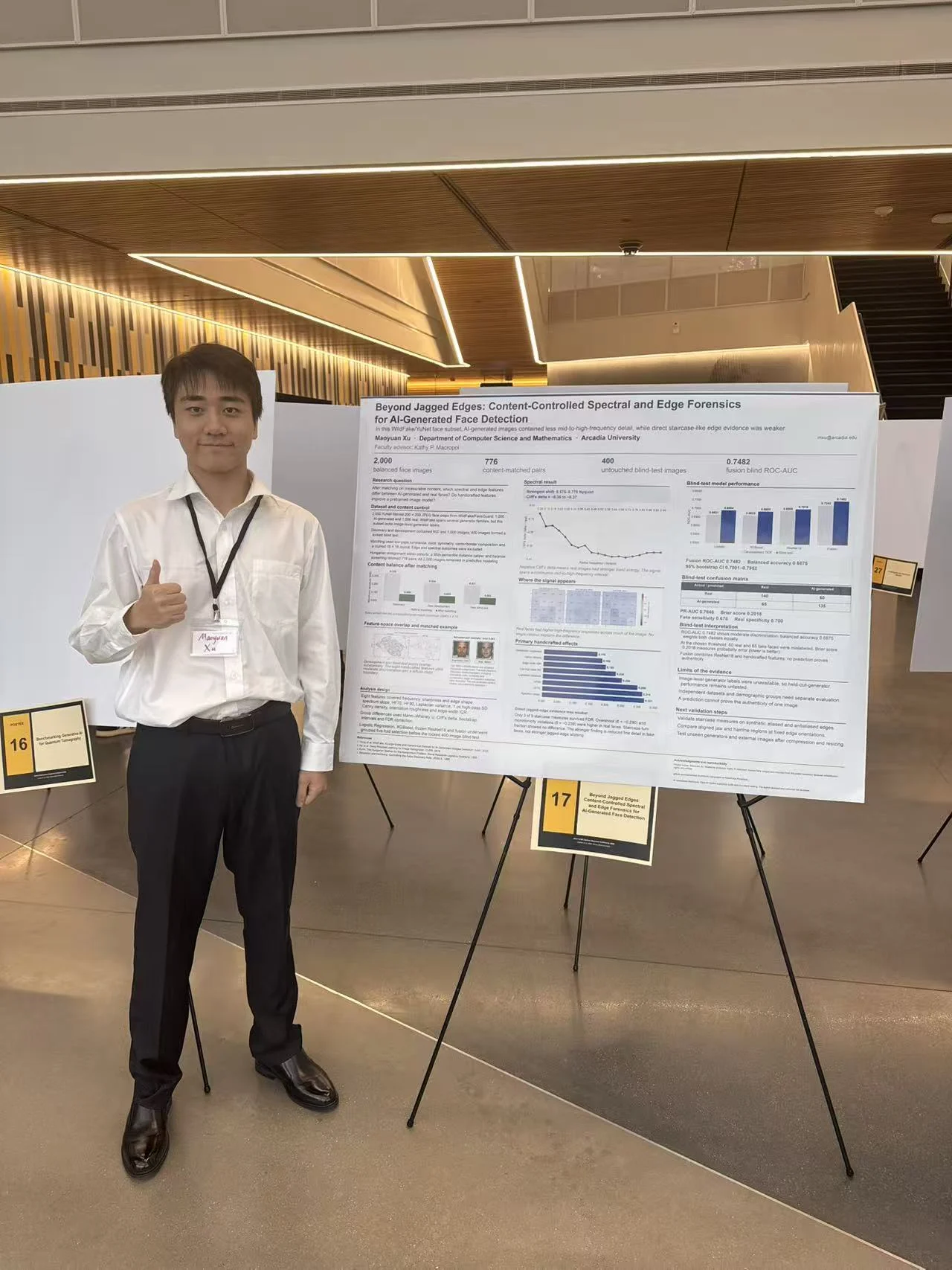
Can simple, interpretable image measurements help distinguish generated faces from real photographs after reducing differences in image content? A detector can look convincing while exploiting brightness, composition, compression, or source-specific artifacts. I wanted to examine the evidence behind the prediction, including whether a commonly suggested cue, jagged edges, actually explained the observed differences.
The study used 2,000 balanced face images from a WildFake-derived, YuNet-filtered collection. A 600-image discovery cohort supported feature investigation. The complete predictive evaluation used development data and a separate 400-image internal test. These are different stages of one study, rather than independent external benchmarks.
My approach
I extracted eight spectral, sharpness, and edge measurements. Hungarian assignment paired real and generated images using measurable low-frequency content, with balance screening retaining 776 matched pairs across predefined cohorts. Matching supported controlled comparisons; the predictive dataset still contained all 2,000 images.
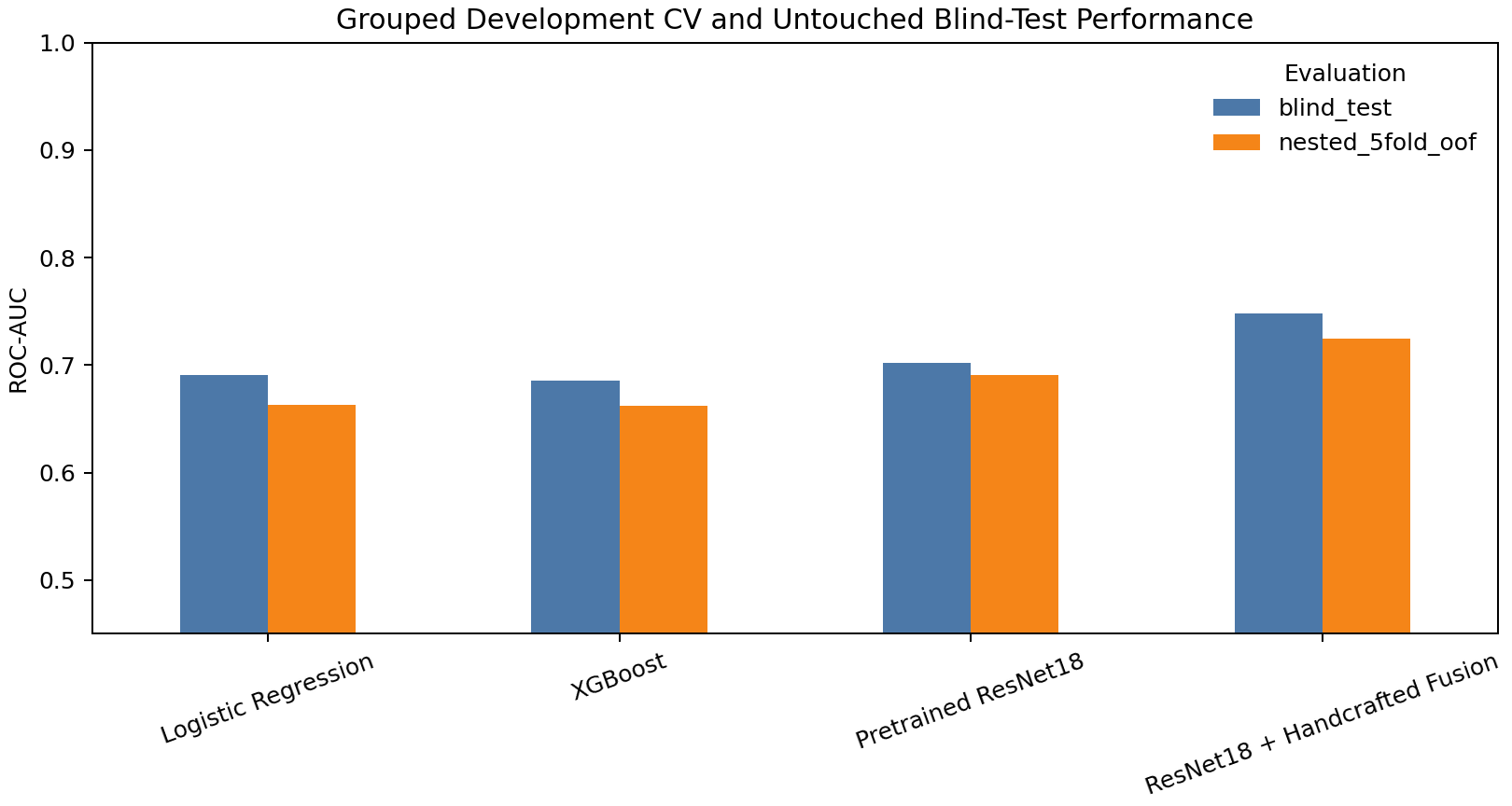
I compared logistic regression, XGBoost, frozen pretrained ResNet18 features, and a feature-fusion model. Development-fold preprocessing and grouped validation helped separate model selection from final evaluation. The main pattern was reduced fine-detail energy in this generated subset. Direct staircase-edge measures were weaker, so the finding does not support a general claim that all AI images have jagged contours.
Results and interpretation
| Model | Internal test ROC-AUC |
|---|---|
| Logistic regression | 0.690 |
| XGBoost | 0.686 |
| Frozen ResNet18 features | 0.702 |
| ResNet18 + handcrafted features | 0.748 |
The fusion point estimate was 0.7482, with balanced accuracy 0.6875. This indicates moderate discrimination within this collection. It does not establish the origin of an individual picture, and it is not evidence of cross-dataset reliability.
Evaluation versions and next steps
The conference abstract reports a 95% bootstrap interval of 0.7001–0.7952 for the fusion ROC-AUC. The later expanded-manuscript analysis recorded in my CV reports a group-bootstrap interval of 0.6985–0.7927. These are different evaluation records and should not be interchanged. The expanded manuscript is submitted to ACM TRUST 2027; decision pending, not an accepted publication.
The matching solver reached time limits in two blocks, so the retained pair count is not a proof of a global optimum. Independent image sources, generator-level labels, and demographic evaluation are important next steps. Source face images are not redistributed on this website.
Code available on request: contact me. The full submitted manuscript is not posted here.